

Performance marketing isn't what it used to be. In 2026, the game has completely changed. U.S. digital ad revenue reached $259 billion in 2024 (up 15% year-over-year), with search accounting for $102.9 billion and digital video at $62.1 billion. But here's the catch: while ad spending grows, so does the noise. The average consumer sees 6,000-10,000 ads per day, yet engagement rates continue to decline.
The brands winning in 2026 aren't throwing bigger budgets at the problem—they're using AI to work smarter, not harder. According to McKinsey, 71% of organizations now use generative AI in at least one business function, with marketing leading the charge. The result? Companies using AI-powered performance marketing are seeing measurable results: 41% higher brand lift, 55% stronger lower-funnel impact, and significantly reduced customer acquisition costs.
If you're still running performance marketing campaigns the old way—manual bidding, generic messaging, gut-feel optimization—you're already behind. Let's explore what actually works in 2026.
1. Predictive Analytics: Stop Reacting, Start Predicting
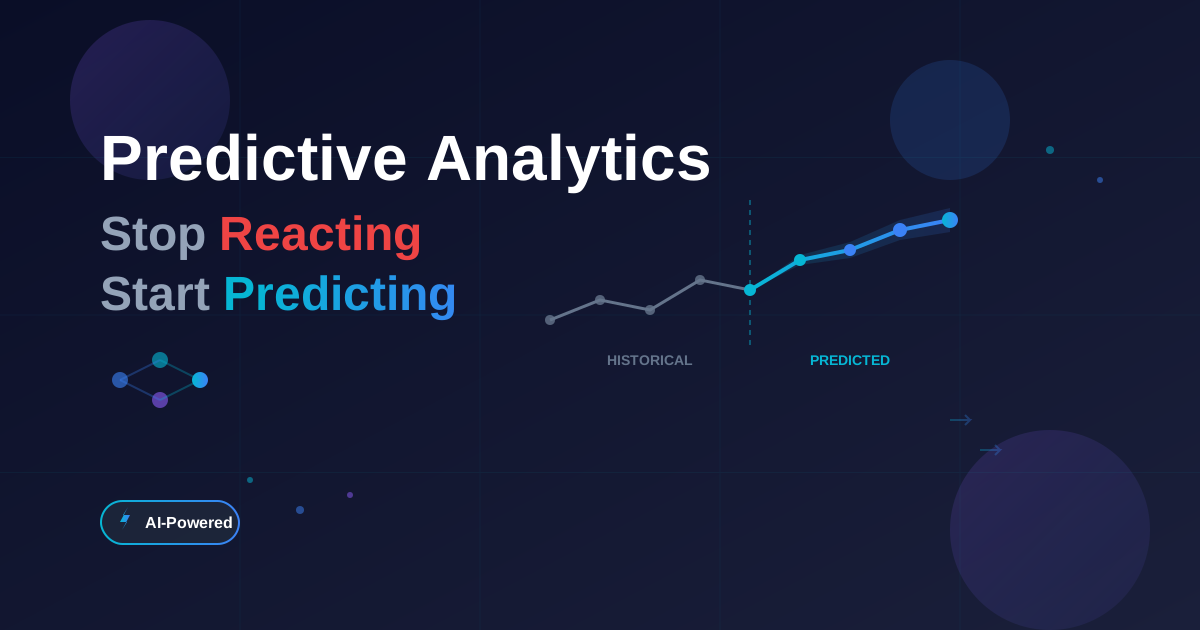
The biggest shift in performance marketing isn't about tracking what happened—it's about predicting what will happen. Modern AI systems can forecast campaign performance, customer behavior, and market trends before you spend a single dollar.
Research from Forrester shows that companies using predictive analytics achieve 73% faster decision-making and 2.9x higher campaign performance compared to reactive approaches. Instead of analyzing last month's data to plan next month's campaigns, AI models can simulate business scenarios and predict outcomes in real-time.
What This Means for Your Business:
- Model campaign outcomes before launch, reducing wasted ad spend
- Identify high-value customer segments before competitors
- Allocate budgets based on predicted ROI, not historical guesswork
- Detect risks early and pivot campaigns while they are still live
At TechPapa, we've seen clients use predictive models to forecast keyword trends three months in advance, allowing them to optimize content proactively and capture market share before competitors even know the opportunity exists.
2. Hyper-Personalization at Scale: The 1-to-1 Marketing Revolution
Generic, one-size-fits-all campaigns are dead. In 2026, buyers expect personalized experiences at every touchpoint—and AI makes it possible to deliver them at scale.
AI analyzes vast amounts of user data—browsing behavior, purchase history, location, social media activity, even the time of day they're most likely to convert—to tailor content, offers, and messaging in real-time. The result isn't just better engagement; it's dramatically improved conversion rates.
According to recent studies, companies using AI-driven personalization see conversion rates improve by 2-3x compared to traditional segmentation approaches. But here's the key: it's not just about volume. Modern AI personalization focuses on intent and timing, delivering messages when they're useful, not just possible.
Real-World Example:
An e-commerce client came to us with a common problem: high traffic, low conversions. Using AI-powered personalization, we analyzed behavioral signals to determine not just who to target, but when. By serving personalized product recommendations based on browsing patterns and predictive intent scoring, we increased their conversion rate by 300% while reducing their customer acquisition cost by 60%.
3. Automated Campaign Optimization: AI Never Sleeps
In 2026, manual campaign optimization is like driving with your eyes on the rearview mirror. By the time you notice a problem, you've already wasted budget.
AI-powered automation monitors campaign performance continuously—not daily, not hourly, but in real-time. Performance signals surface immediately, creative iterations happen faster, and optimization occurs while campaigns are still live.
Tasks that previously required manual effort—bid adjustments, audience refinement, ad rotation, budget reallocation—now happen automatically. Microsoft research shows that teams using AI automation complete optimization tasks 29% faster while maintaining or improving creative quality through human oversight.
What to Automate in 2026:
- Bid management across platforms (Google, Meta, LinkedIn)
- Audience segmentation and targeting refinement
- Ad creative rotation and A/B testing
- Budget allocation based on real-time performance
- Campaign scheduling and delivery optimization
The key insight: AI handles execution and optimization, while humans retain judgment, direction, and strategic oversight. This hybrid approach delivers the best of both worlds—speed and scale from AI, creativity and context from humans.
4. First-Party Data + AI: The New Competitive Advantage
Third-party cookies are dead. Privacy regulations continue to tighten. In 2026, the brands that win are those who own their data—and know how to use it.
First-party data (collected directly from your owned properties) and zero-party data (willingly shared by customers through forms, quizzes, preference centers) have become the foundation of effective performance marketing. When combined with AI, this data transforms from basic insights into predictive intelligence.
Forrester research indicates that businesses deploying Customer Data Platforms (CDPs) achieve 2.4x higher revenue growth by unifying fragmented customer data into real-time profiles that power personalization and campaign orchestration.
How to Build Your First-Party Data Strategy:
- Create value exchanges (calculators, assessments, exclusive content) to capture zero-party data
- Implement a Customer Data Platform to unify data across touchpoints
- Use AI to analyze behavioral signals and predict intent
- Build lookalike audiences based on your best customers
- Respect privacy boundaries—transparency builds trust
5. Search Everywhere Optimization: Beyond Google
The old rules of SEO are dead. In 2026, discovery isn't Google-first—it's everywhere.
AI Overviews in Google, ChatGPT Search, Perplexity, Bing Copilot—your potential customers are using AI assistants to research solutions before they ever visit your website. If your brand isn't visible in these AI-generated results, you don't exist.
This requires a fundamental shift in how you create content. Instead of optimizing for keywords alone, you need to optimize for AI comprehension and citation.
Generative Engine Optimization (GEO) Essentials:
- Structure content in Q&A format with clear, concise answers
- Put the answer in the first 40-60 words (answer-first format)
- Use schema markup (FAQ, How-To, Organization)
- Create authoritative, cited content that AI can trust and reference
- Update content monthly—AI heavily favors recent information
Companies that optimize for AI search are seeing 156% increases in AI citations within 30 days, which translates to 17% more qualified leads. The sooner you adapt, the bigger your advantage.
6. Attention Metrics: Moving Beyond Viewability
Just because an ad appeared on someone's screen doesn't mean they saw it—or that it had any impact. In 2026, smart marketers are moving beyond basic viewability to attention metrics.
Attention measurement quantifies whether an ad was actually seen and processed, not just technically viewable. According to eMarketer, 47% of buy-side decision-makers now prioritize attention metrics, and for good reason.
Adelaide's 2025 guide analyzing 52 case studies found that campaigns optimized for attention metrics averaged 41% higher brand lift and 55% stronger lower-funnel impact. Similarly, IAS/Lumen research ties high-attention impressions to significantly higher conversion rates and lower cost per acquisition.
The message is clear: in a world drowning in ads, actual attention is the scarce resource. Optimize for it.
7. Incrementality Testing: Prove What Actually Works
Attribution is broken. Last-click models give credit to the final touchpoint while ignoring everything that actually drove the decision. Multi-touch attribution spreads credit around without proving causality.
In 2026, sophisticated marketers use incrementality testing—comparing outcomes between groups who saw your campaign and control groups who didn't. If it doesn't move the holdout group, it didn't move the business.
Combined with Marketing Mix Modeling (MMM) for budget allocation and continuous experimentation, this approach gives you causal proof of what's working. Google's measurement playbook recommends a triangulated approach: MMM for strategic allocation + incrementality tests for validation + MTA where signal quality allows.
Why This Matters Now
Performance marketing in 2026 is measurable, adaptive, and increasingly AI-driven. The brands that thrive aren't those with the biggest budgets—they're the ones who set clear outcomes, instrument their customer journeys end-to-end, and use AI to optimize continuously while maintaining human strategic oversight.
Here's what sets winners apart:
- They predict, not just react—using AI to model outcomes before spending
- They personalize at scale—delivering 1-to-1 experiences to thousands simultaneously
- They automate ruthlessly—freeing humans for strategy, not spreadsheets
- They own their data—building first-party assets that compound over time
- They optimize for attention—not just impressions
- They prove causality—testing what actually drives business outcomes
The gap between AI-powered performance marketing and traditional approaches isn't narrowing—it's widening. Every day you wait is market share lost to competitors who've already adapted.
Ready to Transform Your Performance Marketing?
At TechPapa, we specialize in AI-powered performance marketing that delivers measurable results. We've helped companies across industries generate 3x more leads while reducing CAC by 60% using the exact strategies outlined in this guide.
Get your free ROI calculator and personalized performance marketing audit.
Contact us today to discover how AI-powered performance marketing can transform your business growth in 2026.
About TechPapa
TechPapa is a leading performance marketing and custom software development company helping businesses leverage AI-powered strategies for measurable growth. With expertise in predictive analytics, marketing automation, and data-driven optimization, we turn marketing investments into predictable revenue.
Visit techpapa.in to learn more.
Kamal Upadhyay, an digital marketing consultant is having 13 years experience in the industry and worked with top IT companies and gained experiences across a diverse group of B2B, B2C and eCommerce clients. Specialist in optimizing return on investment and building performance driven integrated search campaigns. Areas of expertise: digital media strategy, PPC, SEO, display, performance display, remarketing, social media marketing, website conversion optimization, email marketing, mobile & video advertising, multichannel path analysis, web analytics, ecommerce strategy.
About us and this blog
We are a digital marketing company with a focus on helping our customers achieve great results across several key areas.
Request a free quote
We offer professional SEO services that help websites increase their organic search score drastically in order to compete for the highest rankings even when it comes to highly competitive keywords.
Subscribe to our newsletter!
More from our blog
See all posts




Pingback: is orlistat expensive
Pingback: sildenafil citrate heartburn
Pingback: is vidalista safe reddit
Pingback: pantoprazole otc usa
Pingback: metoprolol succinate xl
Pingback: linezolid 600 mg tablet oral
Pingback: metoprolol medicine